'Hot Selfie' Painting Displayed in Twitter Office


Selfie trends or activities to photograph themselves through the camera seems not to fade. Once lined up as the 'Word of the Year' in 2013, has now transformed into a selfie photo painting.

Most popular selfie photos are converted into the painting is nothing but a pose performed by comedian Ellen DeGeneres at the Oscar awards in early March 2014.

Once converted into a painting, it also poses Selfie display at Twitter headquarters in San Francisco, California, United States. In tweet posted by Twitter employee named Lauren Mitcheom, she exhibited the painting and invite Ellen stopped by Twitter headquarters to selfie with the employees there.

Ellen selfie poses is committed as the most popular in the world of Twitter. So no wonder if the employees were so adore microblogging selfie the work.

In the photo to the face of Ellen and invited guests other Oscar awards which is a well-known celebrities, such as Jennifer Lawrence, Meryl Streep, Bradley Cooper, Peter Nyong'o Jr., Channing Tatum, Julia Roberts, Kevin Spacey, Brad Pitt, Angelina Jolie and Jared Leto.

In a period of 3 minutes, the selfie tweet retweeted more than 80 thousand times. Then hit a record retweet at 10:40 AM and at 11:05 PM became the first tweet in retweets more than 1 million times. And on March 5, 2014, the number of retweets reach 3.25 million times.

Since the number of retweets the post, page BuzzFeed reported, Ellen contacted by the Twitter after Oscars telling her tweet that the activity could cause interference in the social media system was made ​​by Jack Dorsey.

5 social network predictions for 2012

Facebook is the power hitter in social networking today, and is likely to drive the most activity and a fair share of the innovation in social networking in 2012. But it's not the only company driving things forward.


That puppy is about to get very, very rich.(Credit: James Martin/CNET)

Here's are five ways social networking is likely to play out in the coming year.

1. Mobile social networking means good news for new social startups
In the U.S., the majority of consumers will soon have smartphones (Neilsen puts the figure at 44% today). Smartphones are about the most important thing to happen to social networking since Harvard sent its acceptance letter to Mark Zuckerberg.

Smartphones know where you are, who your friends are, who's nearby, and soon thanks to NFC, they'll know what you're buying and where. They are the key element of the next, mobile phase is social networking.

Facebook is serious about mobile social networking, but it is not the leader in this space in terms of design or technology. Smaller companies, like Path and Milk (with its first app, Oink) are coming out with new takes on mobile interaction. Square could play in this economy as well. All these services will likely use Facebook's network to put people or businesses or in touch with each other in new ways. More specialized mobile networks (really riders on top of Facebook) will appear next year.

2. Twitter makes big impact with brand marketers
While Twitter's new brand pages won't eat into big advertising or marketing budgets in 2012, the new business-friendly features will make an impact. Twitter is a highly effective platform for spreading brand messages via consumer/fans, and it doesn't take much to create an effective Twitter-based campaign.

While Facebook is still the most important and best social vehicle for marketing, Twitter will matter a lot in 2012 due to its simplicity and effectiveness.

You won't see a Super Bowl ad in 2012 without a Twitter tag on it.

3. Social Networking will tell the tale for the 2012 presidential election
We have seen how social feedback and link-sharing can bomb a presidential campaign: the YouTube and Web reaction to Rick Perry's "Strong" ad. And in 2008 the MoveOn group might have made the critical difference in the Obama campaign.

In 2012, the major political campaigns will be even more dependent on social networks, possibly to the extent that effective social campaigns will be more important than broad-stroke and increasingly expensive TV ads. Certainly, no candidate will be able to succeed without a strong following on each of the major social networks.

4. Google+ remains a critical success but a consumer flop
Google+ has a lot of good features, but it needs much more than that to take on Facebook and Twitter. Even Google's tacit promotion of Google+ on its other services and toolbars won't be enough to make it part of the daily diet of social networks for the hundreds of millions of users that Facebook has in its thrall.

Google+ also doesn't have enough muscle to be a big player as a branding tool, compared to Facebook and Twitter.

Even inside Google, we hear, employees don't use it very much.

So, the prediction? Google won't kill Google+, not after its failures with Orkut, Buzz, and Wave. The company will continue to blend Google+ into its other offerings, in particular GMail, Picasa Web, and its search result pages. But few people in the real world, if any, will switch over from Facebook to Google+.

The smart thing for Google? Buy Pinterest. But this is a predictions story, not an advice column.

5. Facebook and Yelp: Social network IPOs do well
For all the bad-mouthing of the Zynga IPO, it's not doing all that badly. As of this writing, it's down 5% from its offering price, and the stock has only be trading since December 16.

In other words, the stock wasn't priced crazy-high nor crazy-low, and if it doesn't drop much further, its middling out-of-the-gate performance will be unlikely to cool the ardor for social network stock offerings in 2012. Facebook and Zynga are two sides of a coin in the social network business. The one's success fortifies the other.

2012 will be a watershed year for startup IPOs. Facebook is set to go public in 2012, as is Yelp.

Interest in Facebook stock will be high as the company nears its IPO. The fire for this one will be stoked by the press, by politicians holding it up as an example of American technological and economic prowess, and of course by underwriters. From a financial perspective, it's far too early to tell if the IPO itself will be aptly priced. But Facebook's influence is growing, the company is making a lot of money, and a successful IPO will be good news for every social company out there. The forces are lining up to make sure this IPO is incredibly well-orchestrated, and successful in the right ways: that is, it pops when it goes public, but not too much.

Twitter more Popular than Facebook in 2011


Twitter received more media coverage this year than Facebook did. More specifically, Twitter had 50 percent of the mentions when talking about social networks, while Facebook had just 45 percent.


Although Facebook dominates Twitter in many areas, it lost to its smaller competitor in at least one metric for 2011. Twitter was discussed in about 50 percent of media coverage regarding social networks this year, while Facebook was only talked about 45 percent of the time, according to HighBeam Research. The report did not even bother mentioning Google+.
Twitter beat out Facebook in every single month of the year, except for February and April. It even did better than Facebook in September, which is when the social networking giant hosted its 2011 f8 developer conference and made a slew of announcements, including the Facebook Timeline and updated Open Graph.
This is impressive for one simple reason: Facebook dwarfs Twitter. In terms of active users, it’s eight times bigger, and in terms of content shared, it’s 16 times bigger.
Facebook has over 800 million monthly active users as of September 2011 while Twitter has just100 million monthly active users, also as of three months ago. Facebook users share 4 billion “things” every day as of July 2011, while Twitter users shared 250 million tweets every day as of October 2011.
Twitter’s dominance in the media can be explained with one general rule: public first, private second. If you create a Twitter account, by default all information shared on it is publicly available. You have to secure your account if you want to keep your tweets private. On Facebook, it’s a bit more complicated, but by default only your friends can see your content. Menlo Park is, however, trying to encourage public sharing in various cases; I would argue this is the main reason for all those privacy gaffes the company has had over the years.
Three months ago, Facebook launched Subscriptions and this month, Facebook launched a Subscribe button for websites. Given how similar the first is to Twitter’s basic following feature and how the second is basically Twitter’s Follow button, I would argue Facebook wants to get its users (especially high-profile individuals) to share at least some content publicly. We’ll soon see how that plan works out: I wouldn’t be surprised if Facebook has a higher media attention next year than Twitter does.
I’m not sure if Google+ was excluded from the report because its share really was insignificant or if it is simply too new to bother measuring. Either way, third, fourth, and five places were taken as follows: LinkedIn (3.33 percent), Myspace (1.3 percent), and Foursquare (0.71 percent).

How Twitter Brand Pages Help Your Business

While Facebook is notorious for making frequent changes to its layout, settings and other features, Twitter announced that they have some changes on the horizon. If you manage an organization’s Twitter page, I’m sure this will be of interest to you.

How Twitter Brand Pages Help Your Business

Last week, Twitter’s Advertising Blog revealed a redesign of its web and mobile applications, but more importantly, shared some other exciting news; the unveiling of “brand pages.” Similar to how Facebook has pages for brands, Twitter will provide groups with the same option on its platform. What exactly does this entail? The brand pages offer two important benefits:

1. Enhanced Presentation: Unlike the typical user profile, brand pages will feature a large header that can be used to promote your brand with photos, taglines and other visuals.

2. Highlighted Content: One of the greatest benefits to the pages is that brands will have the ability to showcase one tweet which will remain static at the top of the page. This feature provides for more flexibility and control over the placement of important content that visitors see first. After all, you want to motivate viewers to engage and create a lasting impression. For example, if you’re hosting an event and created a video to promote the occasion, selecting the tweet of the video as your promoted tweet can raise awareness of the event. One thing to remember is that the promoted tweet will be auto-expanded so visitors will be able to see the video or photo.

As a manager of multiple Twitter pages for organizations, I’m looking forward to the evolvement of these pages. Marketers will have more options when it comes to promoting their brand on Twitter due to the enhanced layout and ability to “pin” specific tweets and information to the top of the timeline.

As part of its trial phase, Twitter has launched brand pages with 21 partners including: @AmericanExpress, @BestBuy, @bing, @chevrolet, @CocaCola, @Dell, @DisneyPixar, @generalelectric, @Heineken, @HP, @intel, @JetBlue, @Kia, @McDonalds, @nikebasketball, @NYSE_Euronext, @GhostProtocol, @pepsi, @Staples, @subwayfreshbuzz and @VerizonWireless.  To view the pages, you must first download the latest version of Twitter for iPhone or Android which will allow you access to the redesign from your computer.

Twitter hasn’t indicated a date when these pages will be available to the rest of the world, but stay tuned for a launch date in the coming months.

Twitter Demystified: Top 5 Twitter Myths Busted

Twitter Demystified: Top 5 Twitter Myths BustedWhen I speak at events, one of the most common questions I get from professionals is, “What is the purpose of Twitter.” Those of us who use Twitter know what the purpose of Twitter is and how to use it though. But for many, the concept of micro-blogging is still quite a mystery. Once you understand what to tweet, how to tweet and how much to tweet, you are quickly able to make excellent connections, increase your website statistics and search engine ranking, find some of your best brand advocates, and benefit quickly and efficiently from word of mouth marketing. In fact, next to YouTube, micro-blogging on Twitter is one of the quickest ways for information about you, your brand, your business, your products and your services to go viral.
Before one can feel comfortable on Twitter, they must first understand the purpose of Twitter, realize the potential of Twitter and learn how they can use Twitter to meet their overall marketing objectives.  Following, I will discuss and demystify 5 of the top myths about Twitter use for business and give you pointers on how you can get the most out of your Twitter account.
1. There is No Real Purpose for Twitter
When people say this, the reality is, that they simply do not know what to do with Twitter or how to do it. No one expects or should expect to “make a sale” on Twitter. Twitter is not meant to be a Point of Sale. Rather it is a simple and effective way to grab the attention of your target audience. The goal for Twitter is to post content interesting them enough to your readers prompting them to want to learn more about you. When this happens, they friend/follow/connect with you, retweet your tweets if they feel it is something they would like to share with others and they will go to your website and start reading more about you, your company, your products and services.
2. The More You Post the Better
Ahhh, I can assure you, this is NOT the case. The most important thing with social media is to stay active and consistent. But that does not mean inundate your followers with TMI (too much information). I have at least 3 followers I connect with on Twitter who will at times post as many as 10/20/30 and even 40 posts in 1 hour. I kid you not. The worse part is those posts are usually just a title with shortened links to news stories within the field with very little substance from the user himself.
How am I supposed to keep up with everything they post and how can I really determine in 140 characters which posts are better than others for my business and me? Instead, I have been conditioned and learned that when I see their little thumbnail photo, to simply skip over their many posts because it is just too much to digest. (I only stay connected because I use it as an example to educate others).
Another mistake is to carry on @ message conversations on their walls rather than to put those messages into direct messages (DMs) where they can. I will occasionally tweet an @ message to thank someone for following me, but only if they do not allow people to direct message them. But please, don’t get me started on that issue!
When you post so much information that your followers feel you are monopolizing their time, they are likely to skip over your messages or unfriend you all together! No one says everything you tweet has to be your own, but sharing anything more than 2 or three an hour, especially when what your sharing is not your own, is just counter productive to the purpose of Twitter.
3. There Is No Way to Keep Up With My Connections Posts on Twitter
When you have a lot of connections and some of those connections inundate your newsfeed with WAY too many posts, it can start to get overwhelming. At almost every speaking engagement and corporate education program I partake in, people inevitably ask me, “How can I keep up with all of the posts if I have too many connections?”
To answer this question, I explain that as it takes time to get your profiles up and complete, it too takes time for you to get to know your connections. As each new person follows you, his or her tweets will show up on your newsfeed. Start paying attention to the tweets that have been posted over the last hour or so. Determine if the information they are posting is relevant to your social media strategy. If it is not relevant, or you feel you are being inundated, you can simply block that user from posting their tweets to your newsfeed.
Next, start making a note of your favorites and go directly to their profile pages to view what they have to say. If you have too many, you could always create a bookmark folder in your Internet browser and save the profile page URL for revisiting later. Over time you will determine which connections will serve you best to delete and which to follow more closely.
4. Twitter is So Impersonal
I can see how people can think this, because with some people it is. However, you can change that with those you interact with. The first step to this is to personalize your profile. Feature at the least your company logo on your profile to reinforce your brand. However, if you are the only Tweeting on behalf of your company it is best to personalize your Twitter profile with a professional photograph of yourself.
Next, social media is about building relationships, online and off and works best when used in conjunction with traditional face-to-face networking. Social networking is an amazing business tool that conveniently allows you to connect with people all over the world from your desk, but it is not meant to replace human interaction. The goal of making connections on Twitter is to grab people’s attention wanting them to know more about you.
Once you have caught your connection’s attention, the best way to keep Twitter from being impersonal is to send a DM to each person that follows you to simply say, “Hey, thanks for following me…” Not all people will respond in kind, but some will. Once dialog starts keep it moving in forward motion. Share your email and phone number, send an email, pick up the phone and call or if he or she is in your local geographical area, invite him or her to coffee or lunch. Twitter will only be impersonal for those who allow that to happen.
5. Having Incomplete Profiles is Not a Big Deal
What is the purpose of social media? Isn’t it to connect with others? There is so little information to a Twitter profile. But if you are the only one tweeting on your account, be sure to feature a personal photograph of yourself, display your name in addition to your company name, add a personal bio, include a link to your company website and even include additional company information such as phone number, fax and location by uploading a background picture that includes this type information. The easier you make it for your followers to find you the more likely they will connect and stay connected.
Finally, although this is not a myth I think is something most worthy of mention. May people choose to create vanity URLs for their company and Twitter pages, sometimes using a play on words, such as mine IPWatchdog_too (as in also). However, when creating your user name of vanity URL, be sure to take into account the key terms that people will use to find you. If you do not include key terms at least within your bio, it may be difficult for people to find you. Whenever possible, you should use your real name or company name either as the username or in the “Name” location of your profile.

Twitter for iPad: Sharing Content in Tweets

People are increasingly sharing different types of information on Twitter. For example, Tweets point to web pages, photos, videos, hashtags, people, check-ins, and more. Exploring Tweets is a great way to discover new and interesting information. And with devices of all shapes and sizes connecting to the Internet, we’re constantly looking for new ways to make this easier. To date, we’ve created applications for a variety of mobile phones, giving you instant access to Tweets and great content when you’re on the go.

Today we are bringing Tweets to a device that really lets content shine - the iPad.
Twitter for iPad takes advantage of the iPad’s fluid touch interface, letting you move lots of information around smoothly and quickly – without needing to open and close windows or click buttons. There are a few things we want to point out that make this app a really fast and fun way to read real-time content.


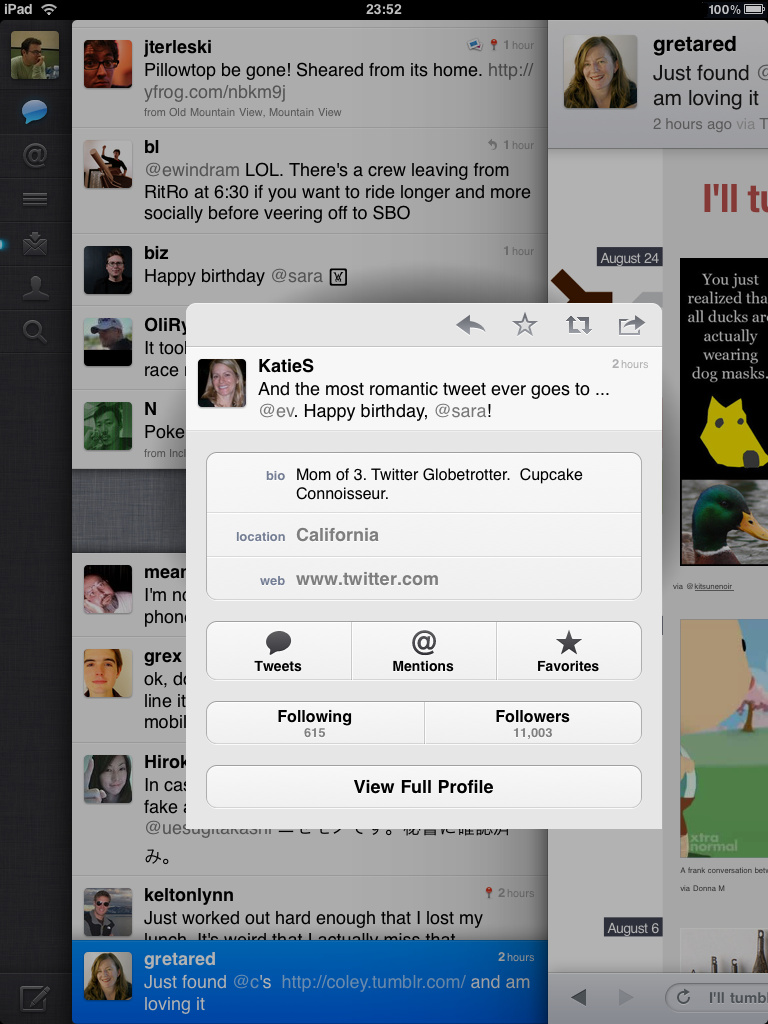
Panes: Tapping on a Tweet opens a pane to the right. Depending on the content in that Tweet, you’ll see a video or photo, or maybe a news story, or perhaps another Tweet. You can continue tapping on Tweets, opening new panes, and getting new content as long as you’d like to. And, it’s really easy to move between panes by swiping to the right or left.


Media: When you tap a video link or open a web page with an embedded video, you can play that video inline. And, let’s be honest, video is great but sometimes it can take some time to load. The panes in Twitter for iPad let you look through your timeline while a video is loading, and then you can just swipe back to the video when it’s ready to play. You can also pinch on a video to watch it fullscreen. Gestures: You can pinch on a Tweet to quickly view details about the author and to take actions on a Tweet, such as reply or retweet. Put two fingers together and pull down on a Tweet to peek at the replies, showing the entire conversation leading to that Tweet.
 
No need to login: You don’t even need to sign up to get started with Twitter for iPad. We’ve selected great Twitter accounts that you can see in various categories, such as Art & Design, Sports, and News. You can also search, view trends, and find breaking news. Sign up at any time to create your own timeline and start tweeting.

Twitter for iPad is available worldwide from the App Store. Try it out and let me, @, and @ know what you think.

Lady Gaga is the most followed person on Twitter


Lady Gaga, Queen of Twitter Photo: AP
A tip of the lobster hat to Lady Gaga, who is now the most followed person on Twitter, having displaced Britney Spears. It’s a triumph against the odds. Who ever could have guessed that the world’s most insufferable self-promoter would excel at a medium that enables celebrities to text banalities to an audience of LOL-speaking sycophants?
Actually, I can think of a more telling accolade. The other week Gaga made it into Private Eye’s Pseud’s Corner after telling Vanity Fair: “I have this weird thing that if I sleep with someone they’re going to take my creativity from me through my vagina.” Hmm. May I suggest that if you regard that part of your anatomy as the source of your creativity, you may not be giving your art enough thought?
But still: almost six million people now follow Lady Gaga’s Tweets. And she’s a prolific user of the site, letting her fans (or “little monsters”) in on such personal insights as how many millions of records she’s sold, and how much airplay her singles are getting. What a daily treat that must be.
Then again, Lady Gaga fans are curious people. One obsessive acolyte recently daubed a picture of the Poker Face singer feasting on the flesh of a dead unicorn. Not so much a little monster, that guy, more a psychopath. But it does raise the question: what kind of weirdo uses Twitter to keep tabs on celebrities?
Twitter is a miraculously user-friendly way of getting real-time news. Use the platform intelligently and it provides access to the teeming brains of the planet’s most brilliant people – writers, comedians, philosophers. But pop stars? Or Hollywood actors? What’s the point?
Celebrity Twitter accounts are supposed to provide insight into their authors’ inner lives. In practice, they reveal nothing. (Admittedly, last year Britney Spears’ stream of sunny updates was interrupted by the ominous invocation: “Glory to Satan.” Disappointingly, it turned out to be the work of a hacker.)
Other famous folk use Twitter for nakedly commercial purposes. Reality TV star Kim Kardashian allegedly earns nice money by Tweeting, shilling for brands such as Reebok. Classy. You wonder if there’s any product she wouldn’t be happy to rave about for a fee. Stannah Stairlifts? Anusol?

Tweets Without Twitter: Twitter Launches Fast Follow


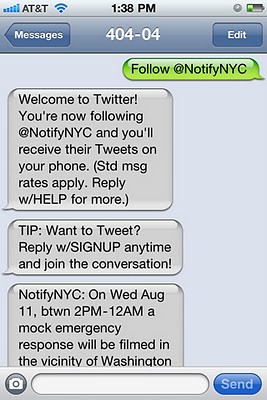
Yesterday, Twitter announced a new service called Fast Follow that allows anyone to receive tweets on their mobile phone without benefit of a Twitter account. You set up the service by sending ‘on [username]’ to 40404 in the US. You turn off the tweets by substituting off for on in your text to the same number.
Fast Follow is kind of a gateway drug to full-blown Twitter usage. The idea being that once you see how fun and helpful tweets can be, you’ll want to have them on your phone all the time.
For you, the marketer, Fast Follow allows you to send your social media message to a wider audience. For example, let’s say you’re a cupcake baker at the county fair. You have your Twitter name printed on cards and flyers that are passed out to the crowd. Now, throughout the day, you send tweets alerting people every time fresh cupcakes arrive at your stand. With Fast Follow, everyone at the fair can get your alerts on their phones, not just people who have Twitter accounts. They “follow you” while they’re at the fair, take advantage of your fresh cupcakes and your Twitter coupons codes, then turn off the tweets when they pack the kids up in the mini-van and go home. Since no signup or logins are required, it’s a fast process and fast means more people are likely to give it a try.
Now here’s a Twitter tip? Don’t want to be bothered by tweets while you sleep? You can go to the mobile settings part of your profile and tell Twitter when you want it to be quiet. Or you could just turn your phone off during the night. How’s that for thinking outside the box? Want to do more with your phone? You’ll find a list of mobile Twitter commands right here.
Time for some brainstorming. How could you use Twitter’s Fast Follow to help advertise your business?

How to Participate in a Twitter Chat

My name is Lisa and I sometimes annoy my Twitter followers by participating in Twitter chats. I don’t mean to be annoying, of course, but I’ve found that Twitter chats provide SMBs an excellent opportunity to meet new people, increase their own influence and gain valuable insight on a particular topic. And when you’re not busy doing that, Twitter chats are also a lot of fun!
If you’re not familiar with them, a Twitter chat is a guided conversation where users interested in a particular topic hop onto the service to chat. The chat is given a hashtag, which makes it easy for anyone looking in to identify the chat and participate. It’s similar to a chat room in that it’s a topic-driven conversation happening in real time; it just happens to be housed on Twitter.
For example, the hashtag #b2bchat refers to a Twitter chat for B2B marketers that takes place every Thursday. Anyone who is interested in B2B marketing can use the hashtag to follow the conversation happening and jump in.
If you’re a small business owner, how can you get in on the Twitter chat action and grow your network? Here’s a quick primer.
Find the Chat
Though most people aren’t familiar with them, there are dozens of scheduled chats that take place every week. There’s probably one specifically related to whatever it is you do, regardless of how niche it is. If you’re looking for chats to get involved with, there’s a running Google Document that keeps track of the Twitter Chat Schedule to help Twitter users find chats that may be of interest to them. There are chats on everything from journalism to PR to interior decorating to being a college student.
For small business owners, here are a few that may be of interest:
  • #smbiz: A chat where small business owners can get answers from experts and other SMB owners. Takes place every Tuesday from 8 to 9pm.
  • #blogchat: Offers advice on how to better your blog. Takes place on Sunday nights from 8 to 9pm CT.
  • #imcchat: This chat is all about integrated marketing communications and takes place Wednesday nights at 8 pm ET.
  • #socialmedia: A chat all about using social media. Takes place every Tuesday at noon EST.
You can also find chats simply by monitoring the hashtags that come through your Twitter stream. If one sounds interesting, click on the hashtag and take a look at what everyone is talking about.
Respect the Hashtag
Every Twitter chat comes with a designated hashtag. This tag is key as it will help you and everyone else to keep track of the conversation happening as part of that discussion. In order to participate in the chat, all of your tweets should include the appropriate tag. If you tweet without it, your tweets are going to fall on mostly deaf ears and fragment the conversation. You want people to see that you are participating in this chat and that you’re interested in whatever the topic is.
Many people who partake in Twitter chats are good about following back other members, so participating in a chat is a good way to increase your influence on Twitter if you prove to be helpful on a certain topic. If you see multiple hashtags pop up, try to include those in your tweet, as well, to make sure that everyone watching can see what you’re saying.
Find Your Tool
You may want to use a Twitter tool to help you monitor the Twitter chat hashtag that you’re following. This will help you isolate the conversation so that your “regular” Twitter stream isn’t polluting it with outside information. Some tools you may want to use:
Show Up Prepared
Do a little research on the Twitter chat you’re joining before you show up. Some chats have rules for how users are supposed to participate; for example, you may need to send in questions ahead of time. You want to be aware of the rules beforehand so that you’re able to participate. You should also be familiar with whoever is hosting the chat and get an idea for what they’re most skilled in and what they’ll be bringing to the table.
If you show up late to a Twitter chat, go back in the tweet timeline to see what everyone is talking about. The worst thing you can do is arrive to a chat 15 minutes late and then interrupt it to ask what the topic of the chat is. You should know this before jumping in.
Participate!
Don’t just sit there, say something!
If you know the topic beforehand, you may want to come with some questions already in mind so that you don’t waste time thinking them up. Knowing what you want to ask will help make sure that you’re getting actionable information from these chats. You can also retweet people who you think made a great point or who asked a question you’d like to see answered.
But don’t just focus on your own needs! Keep your eyes open for opportunities where you can help answer other people’s questions or concerns. This is a great way to grow your authority on Twitter and to be seen as a helpful person. The more you can point people to trusted resources, the better job you’ll do at establishing connections with the people you “meet” via Twitter chats.
Follow Up
After the chat ends, follow the users you enjoyed interacting with and learned from. This helps keep the conversation going and strengthens your ties with those contacts. You may also want to e-mail or send a message to the hosts of the chat to thank them for putting it together or let them know you found it valuable. Twitter chats are a great networking tool, so you should use them as such. The same way you’d follow up after an in-person networking event, you should follow up here as well.
Twitter chats offer small business owners and entrepreneurs a great way to network, share knowledge and increase their own influence. Above are some of my best practices. What are yours?

Time Spent on Facebook, Twitter, YouTube Grows

Social networking is a social phenomenon.

For further proof, just take a gander at new Nielsen research out today. It says Americans spend nearly a quarter of the time they're on the Internet from their PC, or about six hours a month, on social-networking sites and blogs. That's a quantum leap from a year ago and underscores the growing power of FacebookTwitter and YouTube.

The new research also reveals U.S. consumers spend the plurality of their time online, or 36% of it, communicating and networking across social networks, blogs, personal e-mail and instant messaging.

The rise of social networks has enhanced consumption of videos, movies and news and sports articles. "Friends and family are endorsing content to others," says Dave Martin, vice president of primary research at Nielsen.
And the face of that audience is getting older: Twice as many Americans over 50 visited social networks than kids under 18, Nielsen says.

The newfound zeal for the digital lifestyle is epitomized by folks like Dee Jones, 63, who works at a utility company in New Jersey. She says she uses Facebook to connect with co-workers and friends, and Caring.com, a website to exchange viewpoints.

A year ago, she wasn't part of Facebook, which has more than 500 million members. Now, she uses it every other day. "It's a new way for me to socialize," she says. "And I definitely e-mail a lot."

The research on fixed Internet (PC) use, for June, also revealed:
•Online games, led by Zynga's wildly popular FarmVille, overtook personal e-mail to become the second most popular activity. Games accounted for 10% of time spent — eclipsing e-mail, which dropped to 8% from 11.5%.
Half of all Americans online spend some time playing games.
•Videos or movies are another favorite:U.S. consumers, on average, streamed such content three hours, 15 minutes, in June.
•Predictions of the demise of e-mail and instant messaging are premature, the study says. Though both declined in use, e-mail remains the third heaviest activity online (8%) while instant messaging was fifth, at 4%.

"Despite the almost unlimited nature of what you can do on the Web, nearly half of U.S. online time is spent on three activities — social networking, playing games and e-mailing," says Dave Martin, vice president of primary research at Nielsen.

As social networking gains in popularity, its newer members tend to be older, more racially diverse and more varied by social class, says Lee Rainie, director of the Pew Internet & American Life Project.

Still, Americans use the Internet differently from their smartphones and other mobile devices.
Despite a double-digit increase (28%) in time devoted to social-networking services, e-mail activity remained dominant on mobile devices — up to 42% from 37%. Portals such as Yahoo and AOL remain the second heaviest activity (12% of time).